August 28
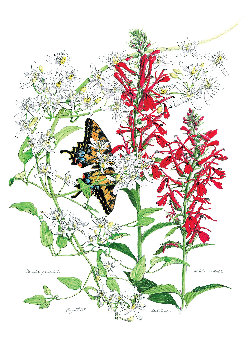
Cardinal Flower
Lobelia cardinalis
Click on picture for a larger image
(c) Linda Fraser
My native plants are like a symphony in which the violins (and violets) play their sweet song at the beginning of sping, but later
the trumpets come in, louder so they can be heard above the violins. Cardinal Flowers are like the trumpets. They command attention,
often rising more than five feet above the earlier plants of spring and summer, and have brilliant red flowers that are a favorite
of hummingbirds. There may be twenty inches of flowers on each stem, but not all at the same time. The lower blooms open first. Weeks
later the top blooms will finish the chorus. I've found that the seed pods from the first blooms can be stripped off the stem
to "clean it up" without harming the blooms above, even though a milky substance does appear briefly. Or, if you need more plants,
leave the seed pods on the stem to ripen; they reseed reliably. The seeds need light to germinate which explains why they show up
in the lawn. Also, a stem can be bent and anchored horizontally onto moist ground to produce new little plants at the stem nodes in
about six weeks. After blooming, cut the stalk back half way and watch for smaller red blooms as late as November. Or, cut it back
all the way to encourage the plant to produce offshoots. Even cuttings can be rooted. So, not only is Cardinal Flower the most gorgeous
flower in your garden, it's free!
The plant over-winters as a low rosette of leaves which doesn't do well under mulch. But a moist area in some sun is preferred. You may find the white flowers of the vine, Clematis paniculata, there at the same time in late summer. It has naturalized and is welcome to scramble over my hollies each summer because the white flowers look great against the dark green. Later the silky hairs on the seeds look like pretty little silk tassels. But that is when I must take a few minutes to pull the vines off and out or I will have too much of a good thing next year.
The butterfly in the painting is a Tiger Swallowtell.
The plant over-winters as a low rosette of leaves which doesn't do well under mulch. But a moist area in some sun is preferred. You may find the white flowers of the vine, Clematis paniculata, there at the same time in late summer. It has naturalized and is welcome to scramble over my hollies each summer because the white flowers look great against the dark green. Later the silky hairs on the seeds look like pretty little silk tassels. But that is when I must take a few minutes to pull the vines off and out or I will have too much of a good thing next year.
The butterfly in the painting is a Tiger Swallowtell.