August 20
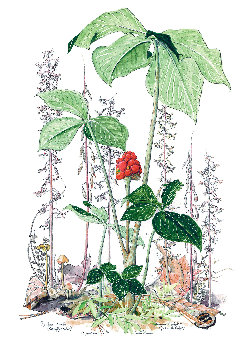
Jack in the Pulpit
Arisaema triphyllum
Cranefly Orchid
Tipularia discolor
Click on picture for a larger image
(c) Linda Fraser
By late summer the pale green flower of Jack in the Pulpit (seen in an earlier painting, May 13) has withered away except for the
cluster of berries which start out green but ripen to bright red.
When I looked for a specimen to paint, I selected the most interesting and colorful cluster. It included a few green and orange berries, immature but the same size as the red ones. After painting them I stood back and realized they looked liked a bunch of M & M candies instead of the typically all red clusters. I redid my painting to illustrate a cluster one would be more likely to find, with insignificant immature berries. In botanical illustration, one needs to resist painting the most extraordinary or unusual--as interesting or as beautiful as that might be--and provide, instead, a realistic means of identification. These red seeds could be planted right away for blooms the third year. With plenty of moisture, Jack in the Pulpit can be over three feet tall, but in ordinary rich woods it will be smaller.
In those same woods you may find Cranefly Orchid blooming, but you'll have to look for them because their mauve and beige color blends into the leaves on the ground (ground clutter in the painting includes beech, maple, pine, sourwood, sweet gum, and tulip poplar). Cranefly Orchid's single leaf is illustrated in another of my paintings, that of the Cranefly Orchid Leaf (February 28), but it disappears before summer and nothing is there until the leafless stalk of little orchids comes up by itself in late summer. You must get on your hands and knees to really see the orchids. So, if you have several stems, pick a few to put in an empty perfume bottle near your telephone and enjoy them there. A leaf comes up later, for the winter. The dark green on top, and magenta underneath, is very pretty in the snow.
When I looked for a specimen to paint, I selected the most interesting and colorful cluster. It included a few green and orange berries, immature but the same size as the red ones. After painting them I stood back and realized they looked liked a bunch of M & M candies instead of the typically all red clusters. I redid my painting to illustrate a cluster one would be more likely to find, with insignificant immature berries. In botanical illustration, one needs to resist painting the most extraordinary or unusual--as interesting or as beautiful as that might be--and provide, instead, a realistic means of identification. These red seeds could be planted right away for blooms the third year. With plenty of moisture, Jack in the Pulpit can be over three feet tall, but in ordinary rich woods it will be smaller.
In those same woods you may find Cranefly Orchid blooming, but you'll have to look for them because their mauve and beige color blends into the leaves on the ground (ground clutter in the painting includes beech, maple, pine, sourwood, sweet gum, and tulip poplar). Cranefly Orchid's single leaf is illustrated in another of my paintings, that of the Cranefly Orchid Leaf (February 28), but it disappears before summer and nothing is there until the leafless stalk of little orchids comes up by itself in late summer. You must get on your hands and knees to really see the orchids. So, if you have several stems, pick a few to put in an empty perfume bottle near your telephone and enjoy them there. A leaf comes up later, for the winter. The dark green on top, and magenta underneath, is very pretty in the snow.