July 30
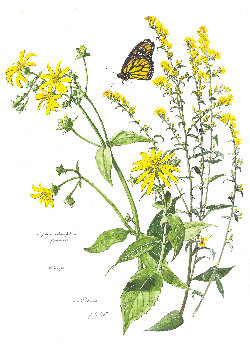
Goldenrod
Solidago sp.
Rosinweed
Silphium sp.
Click on picture for a larger image
(c) Linda Fraser
These two perennial native plants can be found standing tall together in late summer, in dry woods or open places. They have been
thriving for centuries without any help from man. Consider how beautiful they are just as hobos along the roadside. Given some grooming
and a safe place in your garden they will surpass that beauty and bring gold to a refined courtyard. In fact our goldenrods have been
treasured bedding plants in Europe ever since they were brought from the New World, and Goldenrod has been included in bouquets at
Buckingham Palace. Some people still call them weeds, or worse--the cause of hay fever. But it is, instead, ragweed, that causes hay
fever. Ragweed pollen is lighter than Goldenrod and is easily carried airborne..I assume that is why ragweed doesn't need bright colors
to attract insects for pollen transfer. Identify and pull that villain out of your garden!
But please don't just pull up everything you didn't pay money for at a nursery. When you find an "unidentified growing object" volunteering to grow in your garden, you know that it is comfortable with your soil and light exposure. It may have been brought in by wind, birds, animals, or was just dormant in your soil. Let it grow a year or two to see what it does. You may have discovered something rare. Or at least you may have found the Goldenrod suited to your exact location. With over eighty species of Goldenrod in the United States, there is a Goldenrod for almost any environment, from swamps to roadsides to forests.
The butterfly in the painting is a Monarch. Both Goldenrod and Rosinweed have composite flowers, important sources of nectar for butterflies such as the Monarch on its southern migration to Mexico for the winter. In the spring, the Monarchs' northern migration takes them back to areas where they will find milkweed plants on which to lay eggs. The caterpillar emerges from an egg to feed on the milkweed and then forms a chrysalis. The entire cycle can take place within thirty days resulting in the emergence of the butterfly. It needs nectar so we find it visiting Rosinweed and Goldenrod.
But please don't just pull up everything you didn't pay money for at a nursery. When you find an "unidentified growing object" volunteering to grow in your garden, you know that it is comfortable with your soil and light exposure. It may have been brought in by wind, birds, animals, or was just dormant in your soil. Let it grow a year or two to see what it does. You may have discovered something rare. Or at least you may have found the Goldenrod suited to your exact location. With over eighty species of Goldenrod in the United States, there is a Goldenrod for almost any environment, from swamps to roadsides to forests.
The butterfly in the painting is a Monarch. Both Goldenrod and Rosinweed have composite flowers, important sources of nectar for butterflies such as the Monarch on its southern migration to Mexico for the winter. In the spring, the Monarchs' northern migration takes them back to areas where they will find milkweed plants on which to lay eggs. The caterpillar emerges from an egg to feed on the milkweed and then forms a chrysalis. The entire cycle can take place within thirty days resulting in the emergence of the butterfly. It needs nectar so we find it visiting Rosinweed and Goldenrod.