April 13
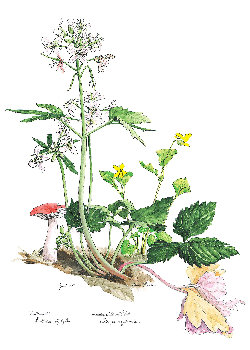
Toothwort
Dentaria diphylla
Smooth Yellow Violet
Viola pensylvanica
Click on picture for a larger image
(c) Linda Fraser
All winter I could see new little basal Toothwort leaves peeking up from the leaf mulch. They were waiting for their turn to perform
in the garden. Now in early April, right on cue, comes the stem of whitish flowers from six to twelve inches tall. Just below the
flowers there are two almost opposite leaves on the stem. Those leaves and the basal leaves are deeply dissected into three parts.
Toothwort is a spring ephemeral plant; it disappears by summer each year. In the painting, one leaf has already started this disappearing act. But during the summer dormancy, the rhizome will be alive and well at the moist soil surface, under a mulch of leaves. The rhizomes will spread and send slender white roots about five inches down into the soil. Some people eat the rhizome as a radish. Toothwort is in the mustard family and is a perennial, coming back to bloom each year from the rhizomes. Seeds are not reliable and take three to four years to bloom.
The Smooth Yellow Violet is one of over seventy-five violet species in the United States. Despite the name, there are many yellow "violets." This one is a "stemmed" type because there are leaves on the flower stalk. If the flowers and leaves each rose on separate stalks it would be "stemless." Honestly, I didn't make this up.
There used to be a popular song that started with "Please, please! Don't eat the daises." Well, you may eat the violets (and the leaves if you'd like--which are very high in vitamins A and C). The
colorful flowers are there for us to pick because the plant doesn't rely on them for seed production. Seeds are produced in summer and fall by pod-like self-pollinating flowers without petals.
The mushroom in the painting is a Russula emetica. Russula emetica.
Toothwort is a spring ephemeral plant; it disappears by summer each year. In the painting, one leaf has already started this disappearing act. But during the summer dormancy, the rhizome will be alive and well at the moist soil surface, under a mulch of leaves. The rhizomes will spread and send slender white roots about five inches down into the soil. Some people eat the rhizome as a radish. Toothwort is in the mustard family and is a perennial, coming back to bloom each year from the rhizomes. Seeds are not reliable and take three to four years to bloom.
The Smooth Yellow Violet is one of over seventy-five violet species in the United States. Despite the name, there are many yellow "violets." This one is a "stemmed" type because there are leaves on the flower stalk. If the flowers and leaves each rose on separate stalks it would be "stemless." Honestly, I didn't make this up.
There used to be a popular song that started with "Please, please! Don't eat the daises." Well, you may eat the violets (and the leaves if you'd like--which are very high in vitamins A and C). The
colorful flowers are there for us to pick because the plant doesn't rely on them for seed production. Seeds are produced in summer and fall by pod-like self-pollinating flowers without petals.
The mushroom in the painting is a Russula emetica. Russula emetica.